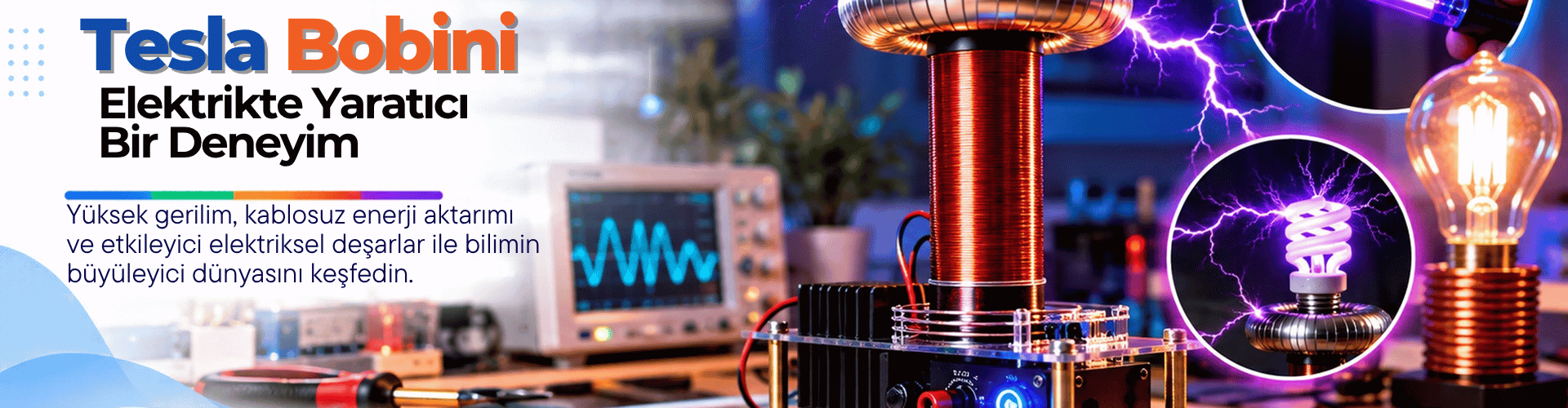
Electricity is among the most dramatic forces in nature, and few devices turn it into a visible, musical, and creative spectacle like the Tesla coil. Originally developed by Nikola Tesla in the late 19th century, this resonant transformer produces high-voltage, high-frequency electrical discharges that can light fluorescent tubes wirelessly, create arcs, and inspire modern electronic projects. Whether you are a hobbyist, student, or engineer, understanding the Tesla coil offers both a practical learning path and an unforgettable visual experience. In this guide, we explore how a Tesla coil works, what it takes to build one, and how Hiber Elektronik supports enthusiasts in Adana, Osmaniye, İskenderun, Mersin, Tarsus, and Kozan.
What Is a Tesla Coil?
A Tesla coil is a type of resonant transformer circuit invented by Nikola Tesla around 1891. Unlike a conventional transformer that uses an iron core and operates at standard mains frequency, a Tesla coil is typically air-cored and designed to produce very high voltages at high frequencies. It does not increase energy; it transforms a relatively modest input voltage into a much higher output voltage while reducing current. The result is a series of high-voltage, low-current radio-frequency oscillations that can create impressive corona discharges and streamers.
In technical terms, a classical Tesla coil consists of two inductively coupled LC circuits: a primary tank circuit and a secondary resonator. The primary circuit usually contains a capacitor, a spark gap or solid-state switch, and a few turns of heavy copper conductor. The secondary coil contains hundreds or thousands of turns of fine wire, topped with a metallic terminal that shapes the electric field. When the primary and secondary circuits are tuned to the same resonant frequency, energy transfers efficiently from the primary to the secondary, and the voltage at the top terminal rises dramatically.
How a Tesla Coil Generates High-Voltage Discharges
The operation of a Tesla coil depends on electrical resonance, similar to how a swing moves higher when pushed at its natural frequency. The primary capacitor and primary coil form one resonant circuit, while the secondary coil and its distributed capacitance form another. When the spark gap fires, it closes the primary circuit, allowing the capacitor to discharge rapidly through the primary coil. This creates a high-frequency oscillating current. If the primary and secondary circuits share the same resonant frequency, magnetic coupling transfers energy into the secondary coil over several cycles.
As energy accumulates in the secondary, the voltage at the top terminal increases until the surrounding air ionizes and forms visible discharge channels called streamers. These streamers can extend several times the height of the secondary coil, depending on input power, tuning, and environmental conditions. The discharges are visually striking but generally deliver low average current; however, the instantaneous voltages and radio-frequency currents can be dangerous if proper precautions are not taken.
The Role of the Spark Gap or Solid-State Driver
In a classic spark-gap Tesla coil, the spark gap acts as a crude high-voltage switch. It fires at high frequency and produces the characteristic crackling sound. Modern solid-state Tesla coils replace the spark gap with transistors or IGBTs, enabling precise control, musical operation, and safer low-voltage input circuits.
Tuning and Coupling
Tuning involves adjusting the primary coil tap point or capacitor value so the primary and secondary resonant frequencies match. Coupling should be neither too loose nor too tight; excessive coupling can cause flashovers between primary and secondary windings, while weak coupling reduces energy transfer.
Tesla Coil Construction: Essential Components and Steps
Building a Tesla coil is a challenging but rewarding project. Before starting, it is helpful to understand the main subsystems and their function. A well-built coil requires careful winding, solid electrical connections, and patience during tuning.
Secondary Coil and Top Load
The secondary coil is typically wound with many turns of thin enameled copper wire on a non-conductive cylindrical form such as PVC or acrylic. The top load is usually a metal toroid or sphere that increases the effective capacitance and shapes the electric field to produce longer, smoother discharges. The secondary coil should be coated with an insulating varnish or left clean to reduce corona losses.
Primary Coil and Capacitor Bank
The primary coil often consists of a flat spiral or helical winding made from thick copper tubing. It must handle high pulse currents. The capacitor bank stores energy and discharges through the primary coil. For spark-gap designs, capacitors must be rated for high voltage and pulse duty, such as MMC (multi-mini capacitor) arrays.
Power Supply and Driver Circuit
A neon sign transformer, flyback transformer, or solid-state driver can supply the coil. In solid-state designs, a driver circuit switches the primary current at the resonant frequency and can modulate it to play music. The power supply must be properly fused and current-limited.
Safety Rules for Tesla Coil Projects
Tesla coils produce high-voltage radio-frequency energy and must be treated with respect. Always operate coils in a dry, open area away from flammable materials. Wear safety glasses, and never touch any part of the circuit while it is energized. The spark gap and primary tank capacitor can retain a dangerous charge even after power is removed, so discharge all capacitors with a proper safety stick before adjustments.
Radio-frequency interference is another concern. A Tesla coil can disrupt nearby electronic equipment, pacemakers, and communication devices. Maintain a safe distance from sensitive electronics, and use a grounded enclosure or Faraday shielding when necessary. If you are new to high-voltage work, build a small, low-power kit first and follow local electrical safety regulations.
Experiencing Tesla Coil Creativity with Hiber Elektronik
For electronics enthusiasts in Adana, Osmaniye, İskenderun, Mersin, Tarsus, and Kozan, Hiber Elektronik offers guidance and professional support for Tesla coil and related high-voltage projects. Whether you want to build a mini Tesla coil kit, experiment with wireless power transfer, or understand resonant circuit design, working with experienced suppliers helps reduce trial-and-error and improves safety.
Hiber Elektronik emphasizes quality components and practical learning. A Tesla coil is not just an electrical experiment; it is a creative experience that combines physics, engineering, and visual art. From small tabletop sparks to larger demonstrations, each project helps you understand high-frequency alternating current, resonance, and electromagnetic fields in a hands-on way.
Creative and Educational Applications of Tesla Coils
Tesla coils are widely used in science demonstrations, museums, and engineering education. They can light fluorescent and neon tubes without wires, demonstrate principles of wireless energy transfer, and generate musical arcs when controlled by solid-state drivers. In artistic installations, Tesla coils create controlled lightning effects for performances and exhibitions.
For hobbyists, building a Tesla coil teaches practical skills such as coil winding, soldering, high-voltage safety, tuning LC circuits, and troubleshooting. These skills transfer directly to radio engineering, induction heating, and high-frequency power electronics.
Tesla coil remains one of the most fascinating intersections of science and creativity. By understanding resonance, high-voltage generation, and safe construction practices, you can turn a historic electrical concept into a modern learning project. Whether you are building a small musical coil or exploring wireless energy ideas, the experience builds both technical skill and visual appreciation for electricity.
For those in the Adana region and surrounding cities, Hiber Elektronik can support your Tesla coil journey with practical advice and quality components. Start with a clear plan, respect high-voltage safety, and enjoy the creative side of electronics.
Ready to experience high-voltage creativity? Contact Hiber Elektronik today to explore Tesla coil kits, components, and expert guidance for your next electronics project.